Causal mapping most often looks for linearity first, while of course being on the lookout for feedback loops and circular shapes. Whereas most systems approaches do the opposite.
Can you spot a complex system when you see one?#
Version 1#
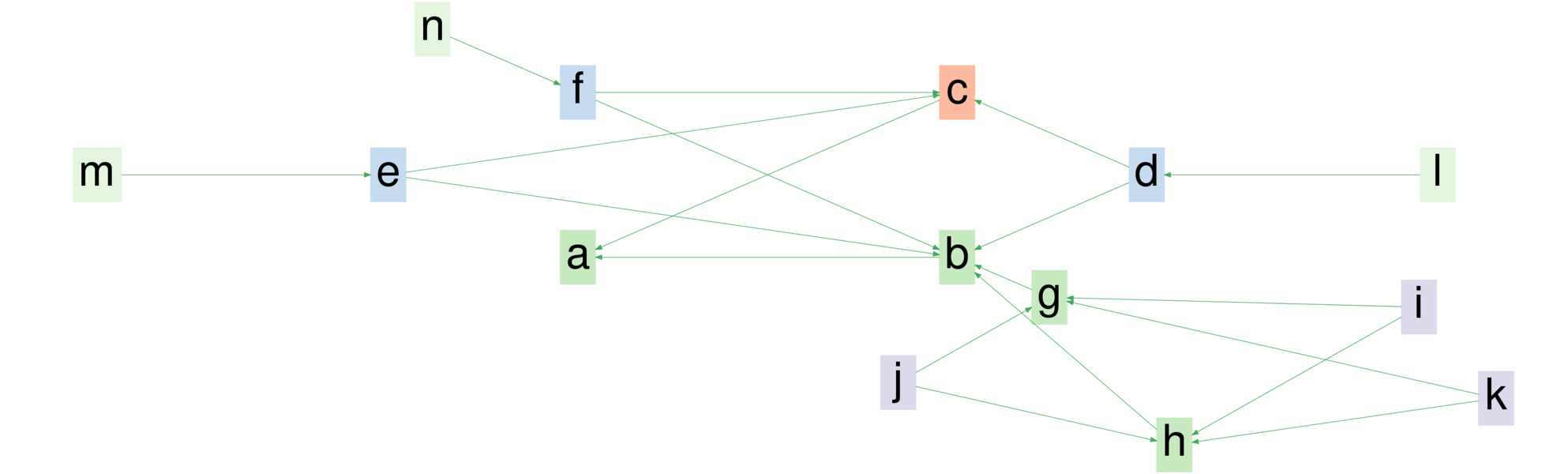
The network pictured above, even though it is quite small, looks pretty tangled. We're not going to fully understand it, so we'd better get out our tools for dealing with complexity? But wait, look at the boring, old-fashioned hierarchy below.
Version 2#
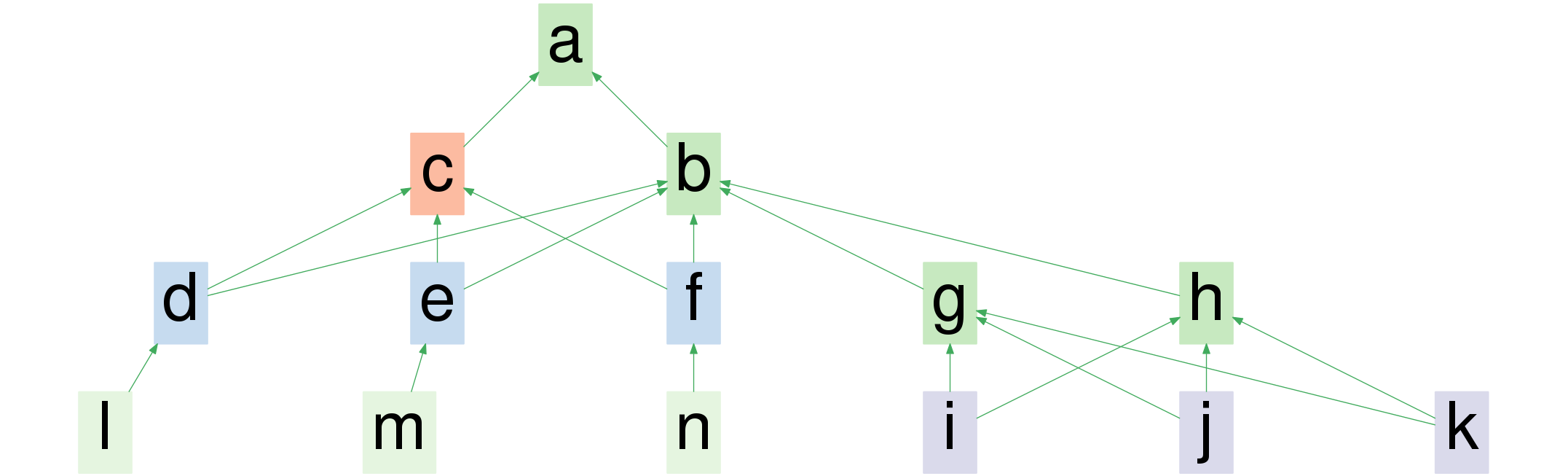 Did you spot that they have exactly the same structure? Now it is easier to see that it is just a hierarchy. D, E and F have one contributor each, whereas G and H share I, J and K as contributors, and feed only into B, whereas D, E and F all feed into both B and C, which feed into A. Easy. Nothing which should be too hard to predict, no balancing feedback loops.
"Complex" and "System" are very buzzy buzz-words at the moment. We should check we don't throw them around too much without thinking. I'm just reading Moore, Parsons and Jessop in the American Journal of Evaluation. They quote Magee and de Weck (2004) who define complex systems as systems "with numerous components and interconnections, interactions or interdependence that are difficult to describe, understand, predict, manage, design, and/or change." Well yes, kinda. But what if you find a system difficult to describe, etc, just because you didn't look hard enough?
Yes, causal maps are just concept maps with only one type of connector, and that connector means "... causes....". Whereas concept maps can have any type of connector you like. Historically, causal maps come from concept maps.
Laying out causal maps is a challenge! Most folks from the systems tradition like swirly circular layouts which make them look like everything is one big feedback loop. If there is a more linear structure, we recommend showing that linear structure.